

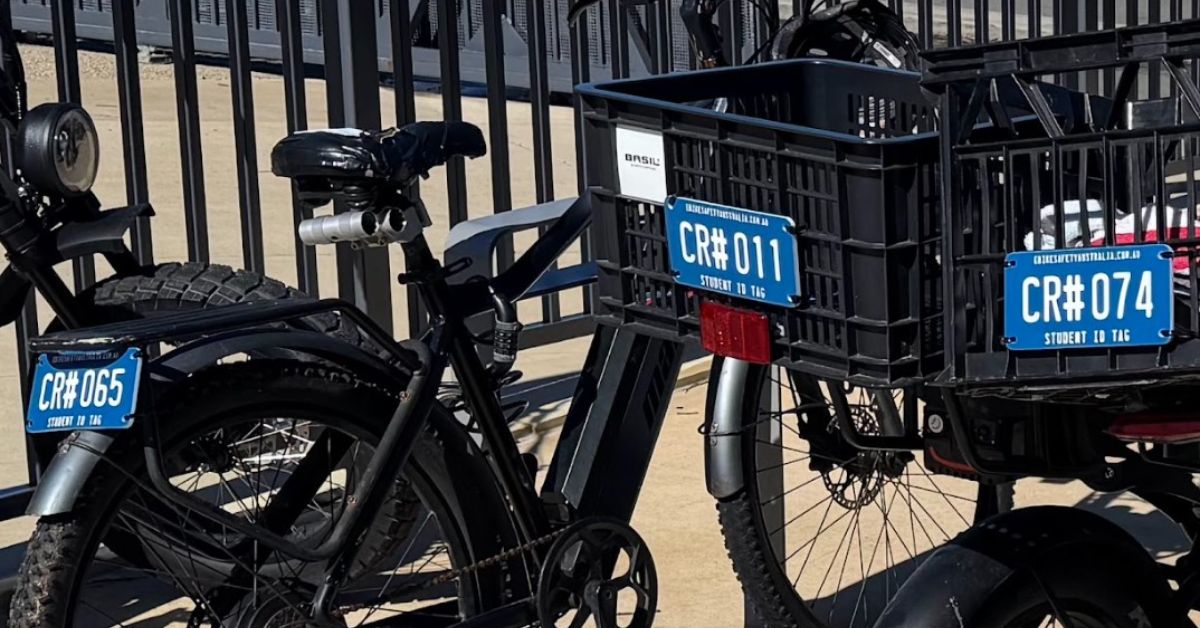
St Luke’s Grammar School in Dee Why has introduced e-bike student ID tags for senior students who ride to school, requiring riders to complete a two-hour online safety course and pass a road rules quiz with a perfect score before receiving a numbered tag linked to their name and attached to their e-bike.
The program, delivered by E-Bike Safety Australia (EBSA), is now running at St Luke’s in Dee Why and The Forest High School at Allambie Heights, making the Northern Beaches an early adopter of a school-based e-bike accountability model that has been piloted across schools in Sydney’s south, the Illawarra and the NSW far north coast.
For the Dee Why community, where the volume of students riding e-bikes to school has grown sharply over the past two years, the program provides a practical local response to a challenge that residents, parents and schools across the peninsula have been grappling with.
How the Program Works
Each EBSA ID tag carries a unique prefix that identifies the rider’s school, allowing any member of the public who witnesses unsafe riding to contact the school directly and quote the tag number. The school then manages the response under its own student wellbeing and safety policies. EBSA itself does not store ID tag data or identify riders by tag number as only the school holds that information.
Before receiving a tag, students must complete an online safety course covering road rules, helmet use, battery safety, riding etiquette and emergency procedures. Upon successful completion, each rider receives a digital licence and the visible school-specific ID tag for their bike.
The source brief confirms students must achieve 100 per cent on the final quiz before the tag and digital licence are issued, and the tag must be attached to the e-bike whenever the student rides in school uniform. St Luke’s also encourages students to keep their tags on their bikes on weekends.
At St Luke’s, principal Geoff Lancaster confirmed 40 students had already received their ID tags at the time of the official program launch, with another 50 from the school’s 1,200-student population having applied. The school has not yet received a public complaint about a tagged rider, though principal Lancaster acknowledged that as more students join the program, incidents will inevitably occur, describing the program’s response mechanism as a proportionate and educational one rather than punitive.
Why E-Bike Numbers Are Rising and Why It Matters
E-bike sales in NSW have grown from under 10,000 in 2017 to an estimated 760,000 e-bikes currently in circulation across the state, a scale of growth that has outpaced both regulation and safety education. On the Northern Beaches, that growth is visible in the daily movement of students riding to school along shared paths, footpaths and roads that were not designed for the volume or speed of modern e-bikes.
As far back as 2022, local schools were approaching community authorities seeking safety resources for students riding e-bikes to school, with many young riders observed not wearing helmets correctly, carrying passengers and riding at high speeds. A community awareness campaign launched in 2024 reached more than 2.78 million views, reflecting the scale of public concern about e-bike behaviour in the area.
Under current NSW law, legal e-bikes must be pedal-assisted, limited to 250 watts of continuous rated power following a December 2025 regulatory change, and must not exceed 25 kilometres per hour under motor assistance alone. Riders under 16 may legally ride on footpaths. The legal framework does not currently require a licence, registration or any demonstrated knowledge of road rules to ride an e-bike, which is the gap the EBSA school program directly addresses at a local level.
What the Program Teaches
The online safety course covers helmet use, battery safety, road rules, riding etiquette and emergency procedures, giving students a structured introduction to the responsibilities that come with riding a motorised vehicle in shared public spaces. For students at St Luke’s, those who have completed the program describe the training as comparable in content and seriousness to the learner driver test, covering the same road rules that motorists must know and applying them specifically to the e-bike context.
The program’s accountability mechanism, the visible ID tag and the school’s authority to withdraw riding privileges, gives the safety education practical weight. A student who rides recklessly near the school or along local footpaths and paths can be identified, reported and counselled or suspended from riding to school, providing a consequence that purely educational messaging cannot deliver on its own.
Growing Use of E-Bikes Among Students
Dee Why sits at the confluence of several busy cycling and riding routes, and its schools draw students from across a wide northern catchment who increasingly choose e-bikes as their primary mode of getting to and from school. The introduction of the EBSA program at St Luke’s Grammar places Dee Why among the first Northern Beaches suburbs to move from general community concern about e-bike behaviour into a structured, school-based accountability response.
E-Bike Safety Australia is currently in discussions with Narrabeen Sports High School about adopting the program, and further Northern Beaches schools are expected to follow as the model proves its effectiveness. Schools, families or community members wanting more information about the EBSA school program can visit ebikesafetyaustralia.com.au.
Published 30-March-2026.